
Magid Abou-Gharbia, Laura H. Carnell Professor and founding director of the Moulder Center for Drug Discovery Research at Temple’s School of Pharmacy, was awarded the John Scott Award for pioneering innovations in drug discovery. Abou-Gharbia holds more than 145 U.S. patents, and his work has led to nearly a dozen novel therapeutics across multiple disease areas such cancer, infectious disease, neuroscience, women’s health and bone disease, and chronic pain.
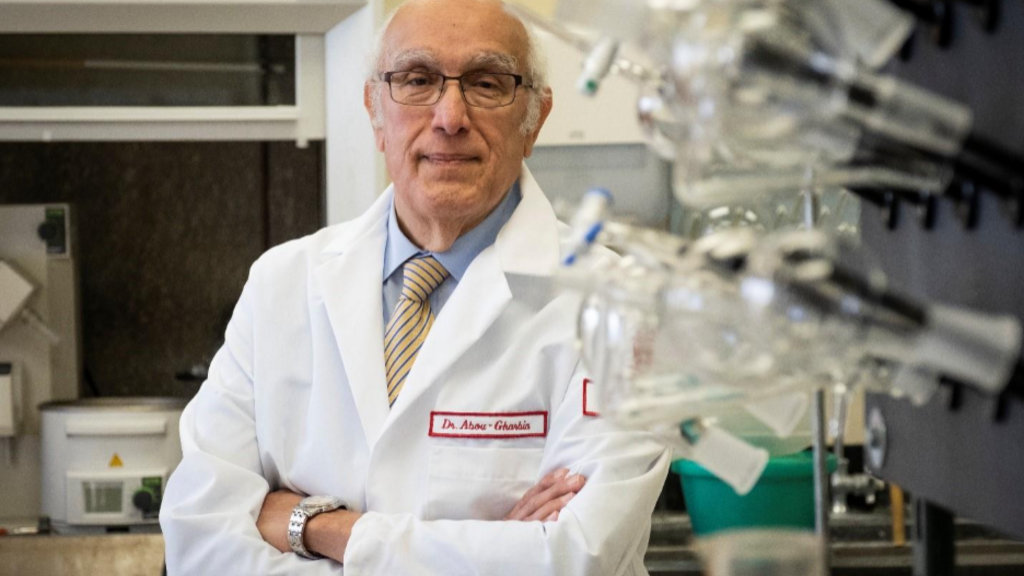
Photo courtesy of Magid Abou-Gharbia
Magid Abou-Gharbia was sorting through his emails as he prepared for a trip to Egypt to deliver a lecture when he noticed an unexpected message.
“I read it, and it said congratulations from the chair of the selection committee of the John Scott Award,” he said. “It was really a pleasant surprise, and I’m very honored.”
Abou-Gharbia, Laura H. Carnell Professor and founding director of the Moulder Center for Drug Discovery Research at Temple’s School of Pharmacy, was one of three scientists selected for this year’s John Scott Award. Presented by Philadelphia’s Board of City Trusts, the John Scott Award is one of the oldest scientific honors in the United States and recognizes innovations contributing to the “comfort, welfare and happiness of mankind.” Notable past recipients of the award include Marie Curie, Thomas Edison, Jonas Salk and the Wright brothers.
This year’s theme was “breakthroughs in human understanding and in drug discovery.” Abou-Gharbia was selected for his groundbreaking work on developing drugs that help treat cancer, depression and chronic pain. He was honored alongside the two other recipients at a ceremony on Oct. 27 at the American Philosophical Society and was presented with a $10,000 cash prize.
“I have been passionate about chemistry ever since I was young,” he said. “I am very honored. I see this as an honor for my talented teams and collaborators over the years, and I’m very appreciative that our work has been recognized.”
Abou-Gharbia is the fifth Temple faculty member to be honored with the award. Previous recipients are Michael Klein, Laura H. Carnell Professor of Science (2020); Masatoshi Nei, emeritus professor of biology and adjunct professor (2017); John Perdew, Laura H. Carnell Professor of Physics and Chemistry (2015); and Franklin Davis, Laura H. Carnell Professor Emeritus (2006).
Abou-Gharbia’s recognition comes as the School of Pharmacy celebrates its 125th anniversary this year. He holds more than 145 U.S. patents and is credited with co-inventing nearly a dozen novel marketed drugs, such as Dezocine, Effexor, Pristiq and Torisel. His honors include two American Chemical Society Heroes of Chemistry awards and induction into the New Jersey Inventors Hall of Fame and the American Chemical Society Medicinal Chemistry Hall of Fame.
After completing his doctorate at the University of Pennsylvania and postdoctoral fellowship at Temple University, the Lewis Katz School of Medicine, School of Pharmacy and Chemistry Department, Abou-Gharbia worked as a bench scientist at Wyeth Pharmaceuticals (which has since been acquired by Pfizer). He rose through the ranks and advanced to senior vice president of drug discovery, leading teams of more than 500 scientists in research that included designing the first antibody-drug conjugate.
Abou-Gharbia’s team developed several first-in-class drugs including the antidepressant Effexor and Mylotarg, an innovative antibody-drug conjugate introduced in 2000 that targets cancer cells while limiting exposure to toxins elsewhere in the body that is still used in chemotherapy treatment today.
“We used to get letters from patients acknowledging how our drugs helped turn their lives around, and this really inspired us about our purpose,” he said.
Abou-Gharbia returned to academia in 2008 and played a leading role in establishing the Moulder Center for Drug Discovery Research, which he led as its founding director until 2020.
“I wanted to inspire the new generation and establish a drug discovery center in an academic setting where we could bring education, research and industry together to collaborate,” he said.
Under his leadership, the center secured more than $30 million in external research grants and funding. Discoveries from the center also led to 15 U.S. patents and four spin-off companies.
“I am so grateful for the support at Temple in establishing this state-of-the-art center. We are all working to advance our mission in education and research and entrepreneurship to bring our findings from the lab to commercialization and get them to patients,” he said.
In addition to his role at the Moulder Center, Abou-Gharbia also served as the School of Pharmacy’s associate dean for research from 2008 to 2019. He was named Laura H. Carnell Professor in 2013, received the Temple University Outstanding Service Award in 2022, and was inducted into the Rho Chi honor society and appointed class faculty advisor in 2026.
After more than 55 years as a medicinal chemist, Abou-Gharbia has no plans to slow down. He currently has active grants and ongoing research focused on designing drugs for alcohol and opioid addiction.
“I’m having fun with the upcoming generation—our students here at Temple and my grandchildren because they are going to be the future leaders in this field. I hope that future John Scott Award recipients will be Temple students, and I absolutely believe that they will be one day.”